

Italian airline ITA has ambitious growth plans.
The airline has undergone a transformation since becoming part of the Lufthansa Group in January. It has synchronized schedules with Lufthansa and linked its Volare loyalty program with the group’s loyalty program Miles & More. Additionally, the airline has exited SkyTeam to join Star Alliance and applied to join Lufthansa’s lucrative transatlantic joint venture with United Airlines and Air Canada, among others.
“The integration part is a huge challenge,” ITA CEO Joerg Eberhart told TPG in an interview in New York on Friday. “Lufthansa has said this will be the fastest integration in the group’s history… We are working hard and Lufthansa aims to complete this within two years.”
In other words, ITA may become a full contributing member of the Lufthansa Group by 2027. This includes the group’s full control of the Italian airline, with its current stake at 41%.
ITA’s transformation and integration comes at a challenging time for the Lufthansa Group. The group trails financially its main European rivals Air France and KLM, as well as International Airlines Group, owner of British Airways and Iberia. In September, executives unveiled a plan to cut costs, increase efficiency and increase centralization to boost profit margins. Integrating ITA with its strategic hub at Rome’s Fiumicino Leonardo da Vinci Airport (FCO) is key to these plans.
In fact, of all the countries in the Americas, the United States figures prominently in Lufthansa’s ITA ambitions.
Future joint venture partners
“Besides the domestic market in Italy, the U.S. market is our most important market,” Eberhardt said.
Lufthansa and United Airlines immediately applied to the U.S. Department of Transportation for approval to include ITA in their transatlantic joint venture (A++). Joining will allow ITA to coordinate flight schedules and fares, jointly market and sell flights, and integrate with partners between Europe and the United States. The agreement also includes Austrian Airlines, Brussels Airlines and SWISS.
A big selling point of the partnership is the promise of new routes and flights, which the airline claims would not be possible without the joint venture. The downside is that travelers lose an independent competitor as airlines jointly price flights in these tie-ups.
Reward your inbox with the TPG daily newsletter
Join over 700,000 readers and get breaking news, in-depth guides and exclusive offers from TPG experts
ITA and United formed a loyalty partnership in September.
“us [will] And then try to organize the ITA network in the same way as the United system connection points,” Eberhardt said.
Eberhart added that Houston’s George Bush Intercontinental Airport (IAH) and Newark Liberty International Airport (EWR) are two United hubs that ITA is considering adding flights to under FCO’s joint venture.
The Italian carrier already serves seven U.S. airports, including Chicago O’Hare International Airport (ORD), New York City’s John F. Kennedy International Airport (JFK) and Dulles International Airport (IAD) near Washington, D.C., according to schedule data from aviation analytics firm Cirium.
Eberhart said ITA hopes to gain U.S. approval to join the joint venture within 12 months, in October 2026, and launch its first joint flight program in the summer of 2027.
Planes (and profits) may slow ITA’s expansion
ITA’s growth plans face at least one major obstacle: airplanes.
The airline has only 22 long-haul Airbus A330-200s, A330-900s and A350-900s flying transatlantic routes. The six A330-900s ordered by ITA are expected to replace the five older A330-200s in its fleet.
“It’s more or less an availability challenge as we look to develop our new technology, the A350,” Eberhart said. “We may look at using the A330-900 as a back-up solution, but then we need to expand the range – we need the A350 for South America, but also Japan and the West Coast.”
He added that Airbus lacks delivery slots for new A350s until the early 2030s, and leases are prohibitively expensive. Still, ITA is looking for second-hand aircraft deals and could benefit from its larger order book when it is fully integrated into the Lufthansa Group.
Lufthansa also faces challenges in purchasing new twin-aisle aircraft due to delays from major aircraft manufacturers Airbus and Boeing and a backlog of the group’s new premium seat suite Allegris.
Then there’s ITA’s balance sheet issue. Lufthansa Group is determined to turn the airline, a reboot of Italy’s historically loss-making Alitalia, into a profitable business. The company reported an operating loss of 46 million euros ($54 million) in the first half of 2025 and aims to be “very close to breaking even” in the second half of the year, as Eberhardt told Italian daily Corriere della Serra in September.
Southern expansion opportunities
Lufthansa Group CEO Carsten Spohr has previously said that FCO is the group’s new gateway to Africa and Latin America.
“Compared to our European competitors, we lack a southern hub, especially for the growing [origin and destination] traffic in and out of Africa and Latin America,” he said in 2021.
Paris-Charles de Gaulle (CDG) is Air France and KLM’s main gateway to Africa, and Adolfo Suárez Madrid-Barajas (MAD) is IAG’s main gateway to Latin America.
ITA is looking at Abidjan, Cote d’Ivoire, Lagos, Nigeria and Bogota, Colombia in Africa; Lima, Peru; and for future growth, Eberhardt said, we will also establish Santiago de Chile in South America. However, while the airline’s fleet of premium-configuration Airbus A321neo aircraft can serve African destinations from FCO, expansion in South America requires additional twin-aisle jets, as does growth in the United States.
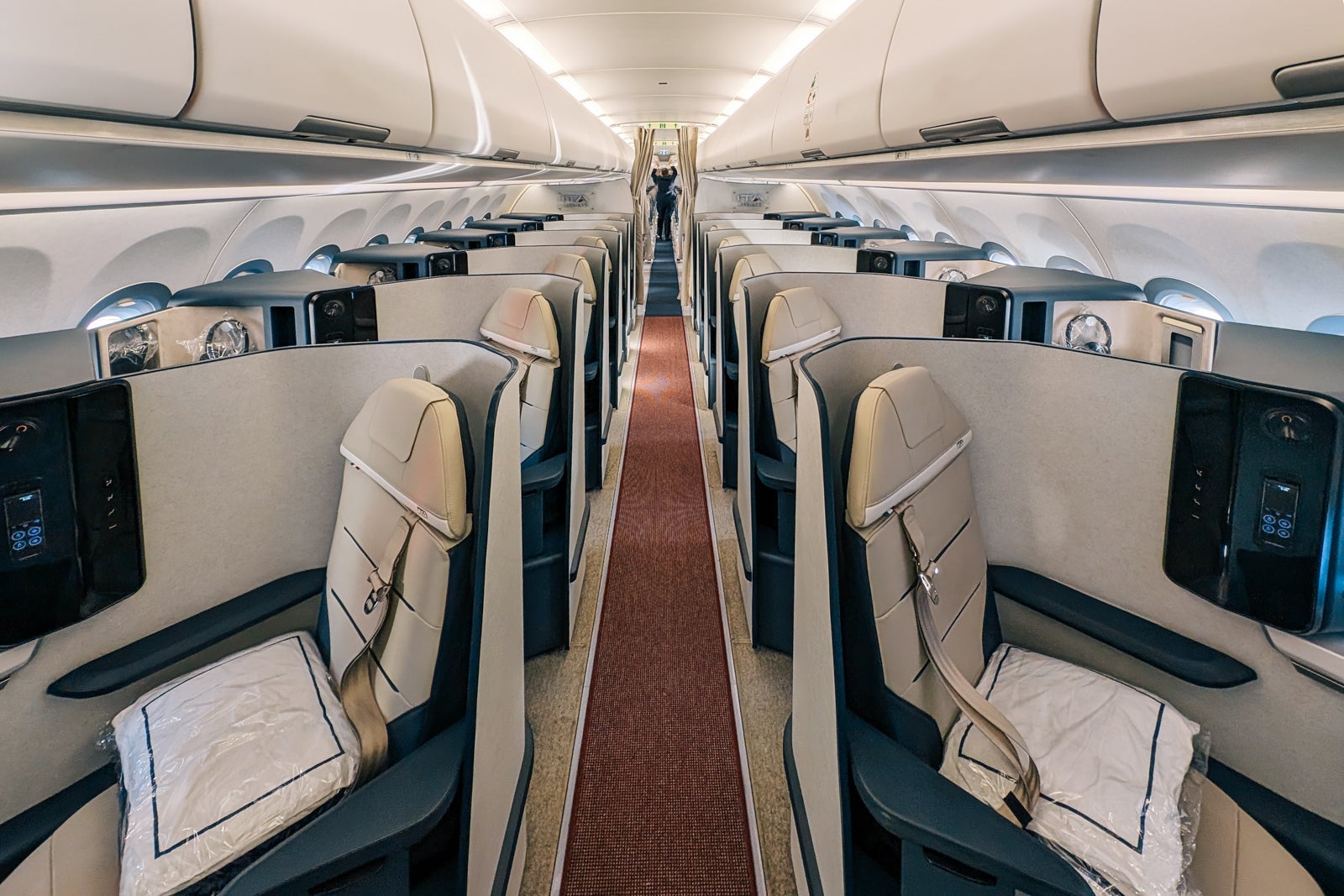
One possibility for ITA is a long-range, single-aisle aircraft. The airline is testing the business case for narrow-body aircraft with advanced layouts on several Airbus A321neos it currently flies to, including airports such as Kotoka International Airport (ACC) in Accra, Ghana, and Blaise Diagne International Airport (DSS) near Dakar, Senegal. Eberhart said if these prove successful, which they will know by 2027, ITA may consider ordering a long-range A321LR or even a long-range A321XLR.
“We did the math and the LR could get from Rome to the East Coast of the United States,” Eberhardt said. “Of course it will cover the whole Middle East [and] All sub-Saharan regions [Africa] destination. “
He added that the A321XLR can fly from FCO to deeper parts of the United States and even to eastern South America in a low-density premium layout.
Loyalty and alliance changes
While ITA awaits aircraft for intercontinental expansion, the airline is moving forward at a breakneck pace thanks to its loyalty and alliance integration with the Lufthansa Group.
The airline plans to merge Volare into Miles & More by the end of February, according to Eberhart. The airline has synced its earn, redeem and status qualifications with the group’s loyalty program.
As for Star Alliance, Eberhart said ITA aims to complete membership of the global airline alliance within the next “six to eight months”, or June 2026. The airline left the SkyTeam alliance in February, and its predecessor Alitalia is a member of the Star Alliance.
“We are already preparing [Star Alliance] Plane uniforms,” Eberhard said expectantly.
Related reading:


