

Parkinson’s Law states:
“Work continues to expand to fill available completion time.”
This “law” was proposed by British naval historian C. Northcote Parkinson in a 1955 satirical article. The Economist. Taken literally, this is clearly wrong. Merely setting deadlines will not achieve your goals in any time frame.
There is a large academic literature suggesting the opposite. The planning fallacy describes the apparent tendency for cost overruns and delays on complex projects. In fact, the truth may be closer to Hofstadter’s Law, with author Douglas Hofstadter half-jokingly saying, “Even taking into account Hofstadter’s Law, it always takes longer than you expect.”
While Parkinson’s Law is definitely an illegitimate empirical state, it does capture a fundamental human truth: when we relax time constraints, the time it takes to do something increases in some way to fill at least some of the gaps.
Energy, rhythm and the limits of human endurance
I was thinking about Parkinson’s Law as I read Alex Hutchinson’s excellent book Endure, which explores the limits of human endurance, and some of the scientific controversy over the exact nature of those limits.
An impressive endurance athlete in his own right, Hutchinson tells the story of his track career as he attempted to beat his personal best in the 1,500 meters. He noted that despite his best efforts, his pace always picked up at the end. He even tried to “trick” himself into running at full speed, but he always noticed the same speed drop midway through the race.
This makes no sense if we assume that endurance is limited primarily by the body’s internal resources (muscle glycogen, VO2, ATP, etc.). If we go all out, how can we possibly accelerate as the race enters its final stages?
However, Hutchinson is not the only one with this quirk. It turns out that world record runs show the same pattern: the pace drops off, then accelerates slightly toward the end of the race. Even the most well-trained, disciplined, and motivated runners are bound to have concerns.
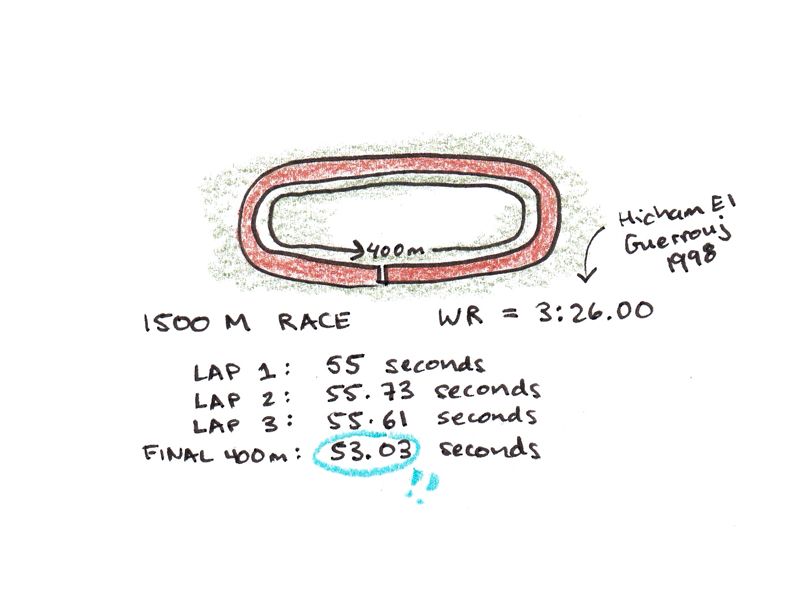
Phenomena like this suggest to some scholars that the real limit to endurance is not in the body, but in the brain. Runners like Hutchinson don’t peak because they reach their true physical limits, but rather because their brains limit performance, so they never risk reaching those limits. This provides plenty of margin to prevent physical injury, and it anticipates future performance demands, stopping some when the race is far from over.
The connection between physical fatigue and mental energy
The existence of “central regulators” that limit athletic performance has evolutionary significance. It doesn’t matter if we set a personal best if we run so hard that we tear muscles, rupture blood vessels, or starve the brain of oxygen.
But do the same rules apply to mental fatigue? After all, no one’s brain is starved of oxygen from stopping procrastination.
The connection between mental fatigue and physical fatigue is interesting. Participants who completed a difficult mental task and then performed an endurance test on an exercise bike gave up earlier than those who did not complete the difficult mental task. Exercise generally improves mental performance, but when we try to complete cognitive tasks while exercising, our performance often suffers.
Some scholars even believe that physical fatigue and mental fatigue are the same thing. Although there are certainly different aspects of this phenomenon (e.g., drowsiness, muscle weakness, etc.), fatigue has a universal component that appears to include both physical and mental effort.
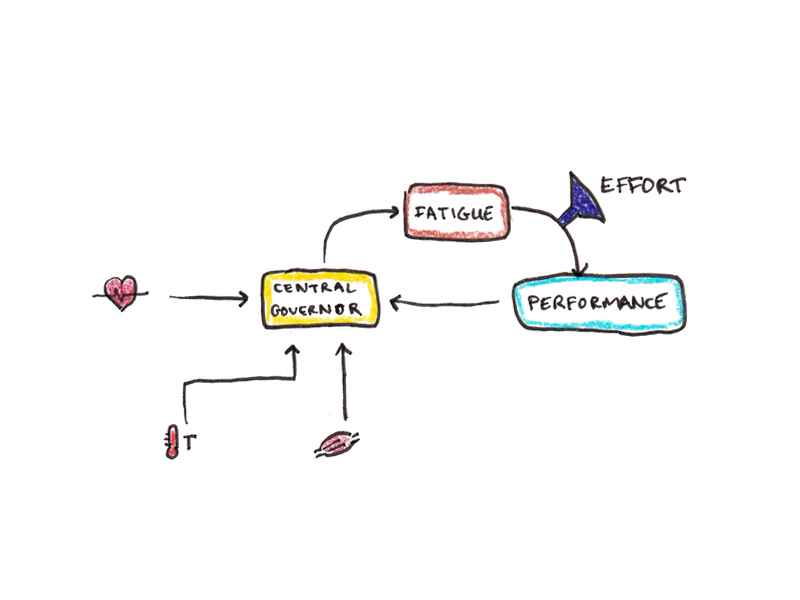
It’s unclear what role mental fatigue plays. Like physical fatigue, mental fatigue may be tracking some underlying biological state: energy availability, local sleep debt, or stress hormones.
Another possibility is that fatigue in general, and mental fatigue in particular, is actually designed to protect us from investing in bad goals. Fatigue begins to accumulate when we work for too long on an activity that lacks intrinsic value and is not immediately satisfying. Perhaps fatigue is a more common emotion that creates pressure to change activities—protecting our bodies from physical overexertion during exercise and protecting our limited attention from being distracted by seemingly uninteresting or futile tasks.
In either case, the effects of mental fatigue are similar to those of physical fatigue: throttling performance to prevent overexertion, both in the present and in anticipation of future demands.
Work less and get more done
I bring all of this up because a key idea in energy management is to work within the natural rhythm of effort and rest. Working non-stop, we burn out. But paradoxically, if we are able to engage in periods of intense concentration with full recovery, we can get more done in less time with less fatigue.
I’m certainly not the first person to point out that we somehow get more done when we limit our working hours to our natural rhythms, a long-standing finding in the productivity literature. From the earliest days of HM Vernon’s discovery that reducing the amount of work done (from the then-common 70 to 80-hour workweek) did not result in less work output, to modern manifestations like fixed-schedule productivity in Newport, California, the paradoxical finding that we are more productive when we force ourselves to work less has long been a staple of self-help.
These ideas about fatigue add an interesting twist to the explanation. If the effort we put into a task isn’t just a measure of our underlying mental abilities, but a subtle “pacing” strategy our brains implement to get the job done, then this explains why punishing, non-stop schedules are so frequent reduce productivity.
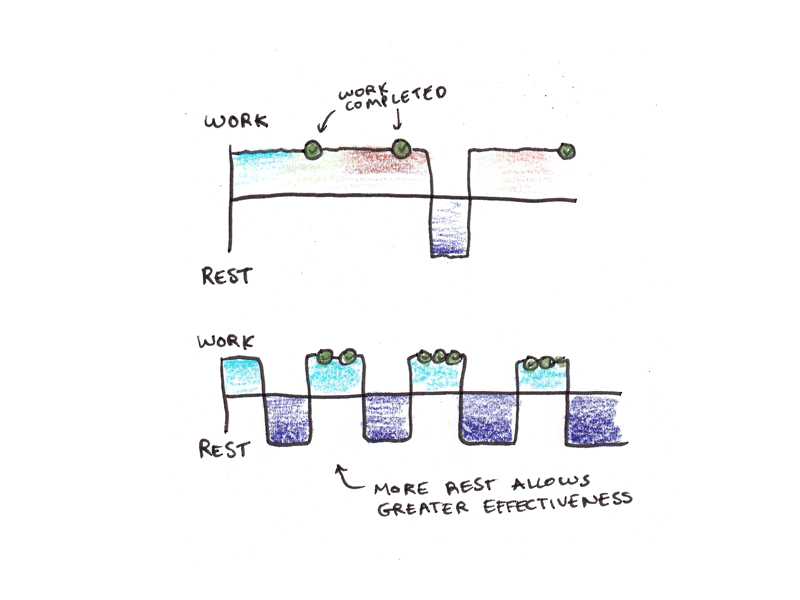
Anticipating that we won’t be able to rest, we unknowingly reduce our willingness to work hard. This may mean staying on task but putting in less effort and accepting a drop in performance. Alternatively, it may mean procrastinating, slacking off, or engaging in menial aspects of the job that are less strenuous and less important.
As a result, the time required to complete a given standard of work is extended, and we get an effect similar to that described by Parkinson in his 1955 paper.
What does it mean to manage energy?
I think this is at the heart of what managing energy is all about. It’s not just about finding “balance” or trading off self-care and work time. Rather, it reflects a fundamental reality: We work best when we have healthy work and recovery rhythms.
Our culture often pits extremes against each other. You are either an ambitious and dedicated striver, or you are a delicate orchid who must avoid excessive stress. Then, predictably, people line up to condemn one side and support the other.
I think the research I’ve been doing shows convincingly that this is a false dichotomy. Meaningful work, a natural rhythm of work and rest, and healthy lifestyle habits such as cultivating good sleep, diet, and exercise: these practices for managing energy are the key not only to working hard, but also to living well.


